
White Paper
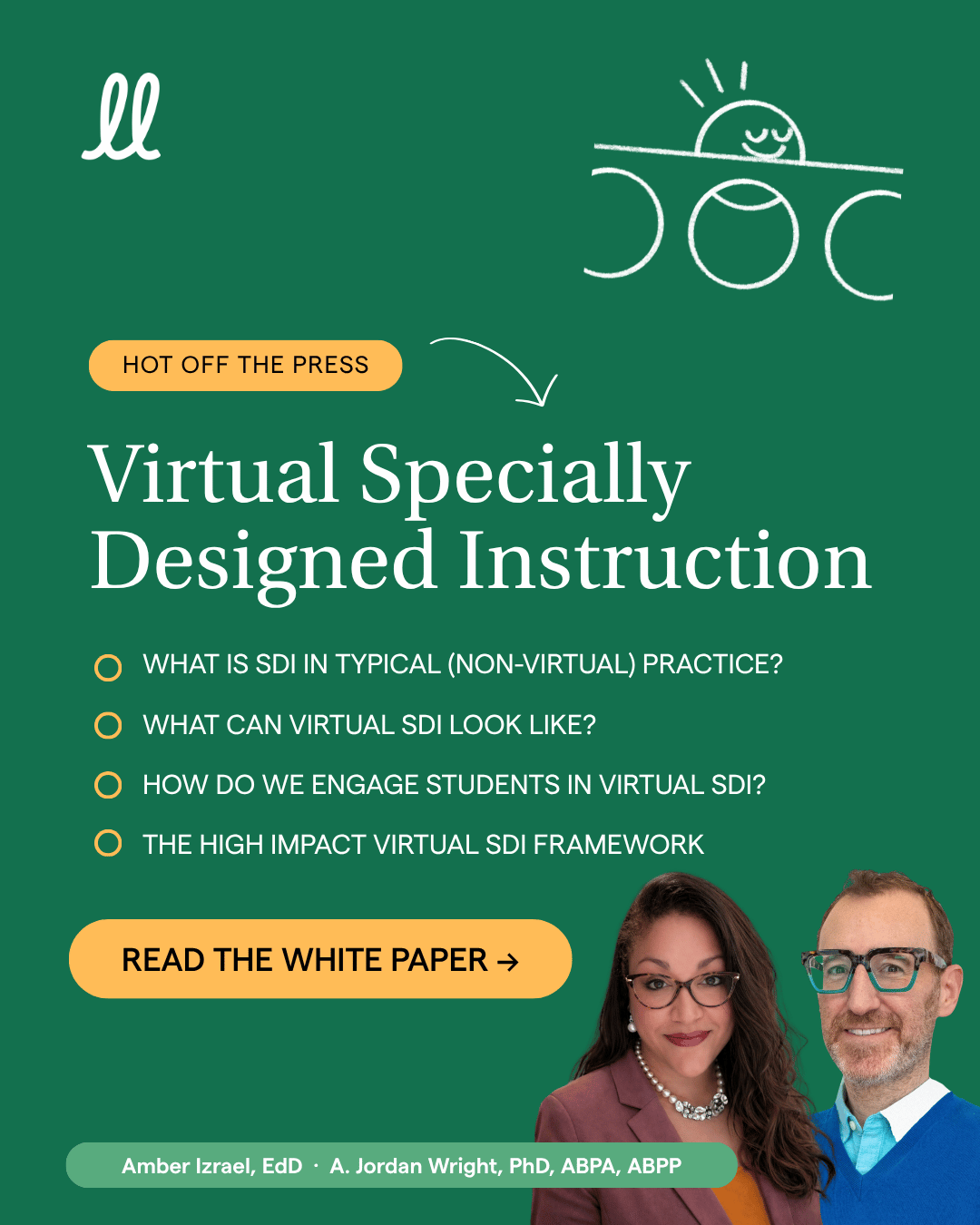
Virtual Specially Designed Instruction
Download to learn how individualized, goal-aligned instruction is designed, engineered, and measured in virtual settings — and why engagement is the leading indicator of academic growth.
Get the full white paper
Free · Add your details & we'll email it to you.
What you'll learn
- What makes instruction "specially designed" under IDEA — and what it rules out
- How SDI differs from differentiation, accommodations, and tutoring
- How to engineer virtual engagement: structure, personalization, accessible entry points
- Why engagement is a leading indicator of academic growth — and where it stops
- The three pillars of the High Impact Virtual SDI Framework, and three delivery models
- How to assess virtual SDI outcomes against IEP goals, and when virtual isn't the right fit
What this paper covers
Specially designed instruction is how students with disabilities access a free appropriate public education under IDEA — federally defined as adapting content, methodology, or delivery to address disability-related needs. In practice it gets used interchangeably with differentiated instruction, accommodations, and tutoring, each of which does something different, and the spread of RTI and MTSS has further blurred who is responsible for instruction at which stage.
The line between them is not setting, staffing, or service location. It is whether instruction itself was intentionally adapted to a student's individualized goals. Extended time and text-to-speech support access without changing instructional methodology; SDI changes how instruction is delivered in order to produce measurable progress toward a goal. The governing question is not whether a student received support, but what was specially designed about the instruction.
Which makes a virtual session a question of design. This paper details how designed instruction is built there — through structure, personalization, and accessible entry points into a task — and describes the instruments a virtual room puts in a teacher's hands: multiple ways for a student to respond, shared annotation inside a text, structure that stays in view, materials that change without a transition.
Engagement is where the design shows first. Many students receiving SDI are not resistant to learning so much as stuck at the start of it, so a student who begins initiating tasks without prompting is showing an early sign of academic growth — though engagement remains a condition for learning, never a substitute for explicit instruction.
Inside: the High Impact Virtual SDI Framework and its three pillars, three delivery models with the student profiles each fits, how to assess outcomes across both academic growth and access to learning, and a case study tracing exactly what produced one student's reading gains.
Who this paper's for
Special education directors, instructional coaches, and the teachers delivering or overseeing virtual services.
World-class providers — unparalleled care

Dr. Jordan Wright
Chief Clinical Officer, Parallel
ABAP, ABPP Board-Certified

Our Assessments
Gold standard assessment batteries using the most widely-accepted psychological and educational tests to help figure out how each specific brain works.
Our Partners

